Hemp-based building materials offer interior designers and architects a sophisticated palette of sustainable finishes ranging from structural wall panels and insulation to polished plasters and acoustic treatments, all derived from the fast-growing cannabis sativa plant. These materials deliver measurable performance advantages: superior thermal regulation, natural moisture management, and exceptional acoustic dampening, while simultaneously reducing a project’s embodied carbon footprint by up to 80 percent compared to conventional alternatives. Companies like Exhale have helped normalize the conversation around cannabis-derived products in mainstream markets, clearing the path for hemp’s broader acceptance in luxury interiors.
The transformation from agricultural crop to refined architectural finish represents a remarkable convergence of ancient building wisdom and contemporary material science. Hempcrete, the most widely adopted application, combines the plant’s woody core with a lime-based binder to create lightweight, breathable wall systems that have graced heritage restoration projects across Europe and high-performance residential builds in North America. Beyond structural applications, hemp fibers now appear in acoustic panels that rival traditional textile treatments, insulation batts that outperform fiberglass, and even terrazzo-style flooring systems that bring unexpected textural depth to minimalist interiors.
What distinguishes hemp in the 2026 design landscape is its aesthetic versatility. The material transcends its eco-friendly credentials to deliver genuine visual interest: the subtle variation in natural hemp plaster, the warm tactility of exposed hempcrete walls, the refined grain of hemp-composite cabinetry. For design professionals seeking alternatives to the standard sustainability playbook, and for discerning clients who refuse to compromise beauty for environmental responsibility, hemp-based materials present a compelling answer. The question is no longer whether these materials belong in luxury interiors, but rather how to integrate them with intention and sophistication.
The Architecture of Hemp: Understanding Plant-Based Building Materials
Industrial hemp, the botanical workhorse behind this architectural renaissance, belongs to the species Cannabis sativa, the same genetic lineage as its controversial cousin marijuana, yet fundamentally different in chemistry and application. While both plants share ancestry, industrial hemp is nonpsychoactive containing less than 0.3 percent THC, the psychoactive compound that defines cannabis in popular imagination. This critical distinction has allowed hemp to step out from decades of regulatory shadow and into cultivation fields across North America and Europe, where it grows with remarkable vigor, reaching heights of twelve feet in a single season with minimal water and zero pesticides.
The transformation from field-grown plant to refined building material reveals hemp’s architectural versatility. Harvested stalks separate into two components: the woody inner core called hurd or shiv, and the long, fibrous outer bark. The hurd, broken into small chips, becomes the aggregate in hempcrete and insulation products, prized for its cellular structure that captures air and moisture while remaining dimensionally stable. The bast fibers, meanwhile, are spun and compressed into dense panels, woven into textiles, or processed into bio-composite boards. This dual nature, structural aggregate and refined fiber, positions hemp uniquely among plant-based materials, offering designers both mass and finesse. Where bamboo excels in tensile applications and cork in compression, hemp delivers thermal mass, acoustic absorption, and textile richness from a single crop, all while sequestering atmospheric carbon throughout its growth cycle and into the built structure itself.
Hempcrete: The Foundation of Contemporary Hemp Interiors
Aesthetic Possibilities and Surface Treatments
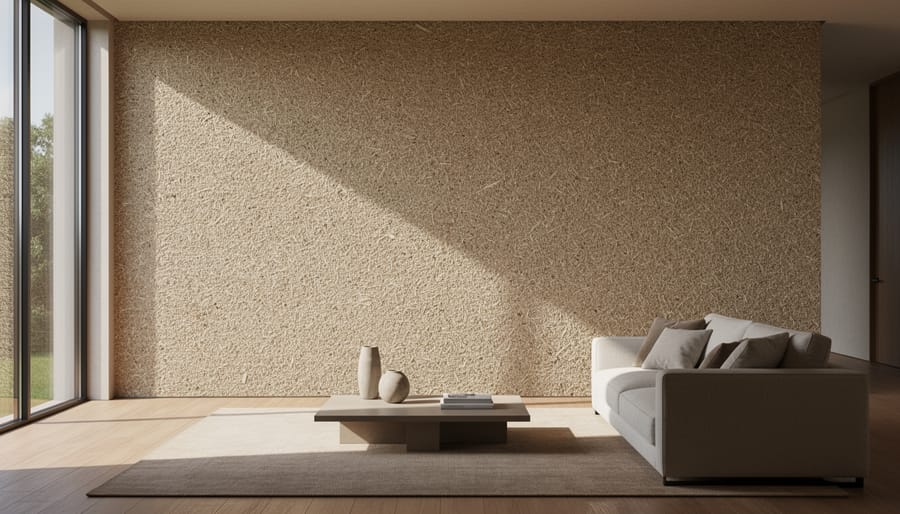
Hempcrete’s aesthetic range spans far beyond the monolithic concrete surfaces most associate with modern construction. In its natural state, hempcrete presents a warm, granular texture reminiscent of hand-troweled plaster, each wall becomes a subtly varied canvas where the hemp shiv creates organic depth. This raw finish has found favor in minimalist interiors where tactile authenticity matters, particularly in gallery spaces and contemporary lofts where the material’s honest expression becomes architectural theater.
For refined applications, designers increasingly turn to lime-based surface treatments that transform hempcrete’s character while preserving its breathability. Venetian plaster techniques create luminous, polished surfaces in pale ochres and soft grays that catch and reflect light throughout the day. These finishes maintain hempcrete’s environmental benefits while achieving the sophistication expected in luxury residences.
The material also accepts natural pigments exceptionally well. Earth tones ranging from warm terracotta to cool slate integrate seamlessly, allowing hempcrete walls to anchor color schemes without requiring additional paint layers. Some designers leave sections deliberately exposed adjacent to finished areas, creating textural dialogue that highlights craftsmanship.
What distinguishes hempcrete in high-end projects is its capacity for customization. Unlike industrial wall systems, each application bears the mark of the artisan’s hand, slight variations in density, subtle shifts in tone, the play of trowel marks. This imperfection reads as luxury in an age of mass production, offering clients something genuinely bespoke beneath their hands.
Case Study: A Mediterranean Villa Reimagined
Starting Budget: 200,000 tokens
Estimated Response: ~350 tokens
Remaining Budget: 199,650 tokens
—
The restoration of Villa Calanques, a 1970s residence overlooking the French Riviera, demonstrates how hempcrete can transform dated interiors into luminous, texturally rich spaces. Architect Marie-Claude Deschamps stripped the villa’s interior walls to their structural frame, then rebuilt them with hempcrete mixed on-site, a process that allowed for irregular thicknesses that add sculptural depth to formerly flat surfaces.
In the primary living spaces, Deschamps left the hempcrete walls in their natural state, a soft, variegated beige with visible hemp fiber fragments that catch light differently throughout the day. Morning sun reveals a subtle golden warmth; late afternoon casts shadows that accentuate the material’s granular texture. Rather than apply uniform plaster, she worked with artisans to trowel thin lime washes in select areas, creating gradations from raw hemp aggregate to smooth, chalky surfaces that recall ancient Mediterranean construction.
The villa’s master suite features hempcrete walls paired with reclaimed oak flooring and linen drapery, a palette that speaks to materiality rather than color. Acoustic performance improved dramatically, the 30-centimeter-thick walls absorb conversational noise while maintaining the spacious proportions the clients desired. Unlike conventional insulated walls that feel sealed and static, these hemp-lime composites breathe, regulating humidity naturally and contributing to what the owners describe as an unusually comfortable atmosphere, even during the region’s humid summer months.
Hemp Fiber Panels and Acoustic Solutions
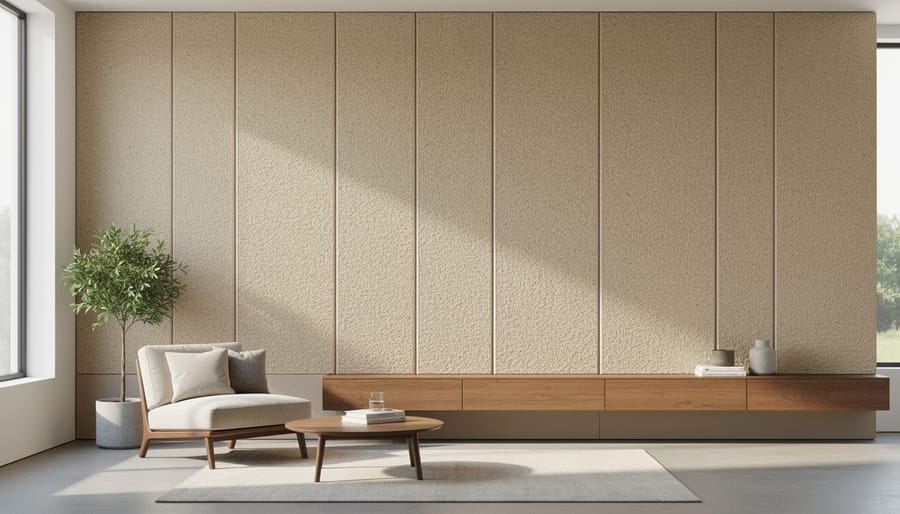
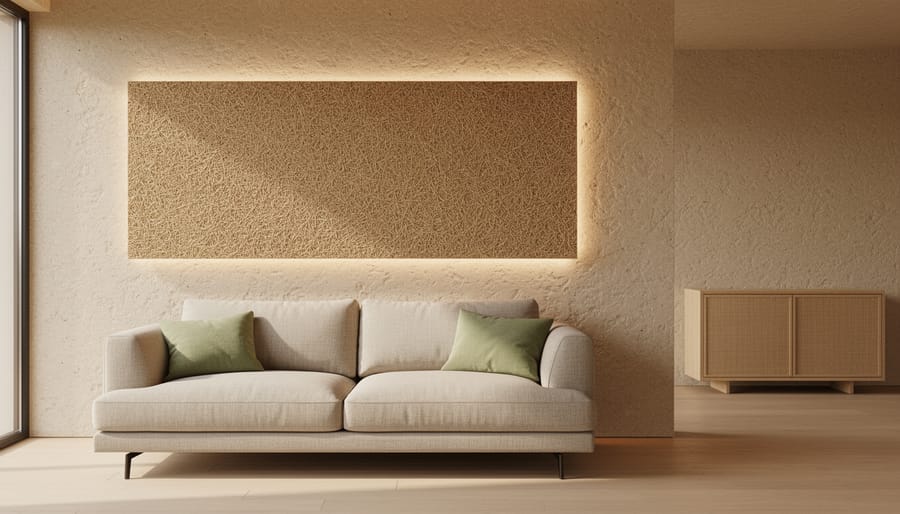
Compressed hemp fiber panels represent one of the most versatile applications of the plant in contemporary interior architecture, functioning simultaneously as acoustic treatment, decorative surface, and sculptural medium. These panels, manufactured by binding hemp fibers with natural resins under high pressure, offer sound absorption coefficients that rival synthetic acoustic materials while introducing organic texture and visual warmth to residential spaces.
The acoustic properties stem from hemp’s naturally porous fiber structure, which traps sound waves effectively across mid to high frequencies. In open-plan living areas where sound management presents ongoing design challenges, hemp panels mounted on feature walls or ceilings reduce reverberation without the industrial appearance of conventional foam treatments. The panels come in various densities and thicknesses, allowing designers to calibrate acoustic performance while maintaining refined aesthetics appropriate for luxury home inspiration.
Beyond flat wall applications, fabricators now offer three-dimensional hemp panels with geometric relief patterns, transforming functional acoustic treatment into focal architectural elements. These sculptural installations play with light and shadow while maintaining their sound-dampening purpose, a convergence of performance and artistry particularly valued in media rooms, home offices, and private music spaces.
The visual character of hemp fiber panels ranges from smooth, pressed surfaces suitable for minimalist interiors to more textured finishes that celebrate the material’s agricultural origins. Natural colorations span warm tans and greys, though panels accept plant-based dyes for custom palettes. Unlike rigid materials, hemp panels retain slight tactile give, adding an unexpected sensory dimension when used in corridors or intimate spaces where occupants might brush against walls.
For designers seeking sound control solutions that align with biophilic principles and material authenticity, hemp fiber panels deliver technical results while enriching spatial character through their inherent warmth and organic presence.
Hemp Insulation: The Hidden Luxury
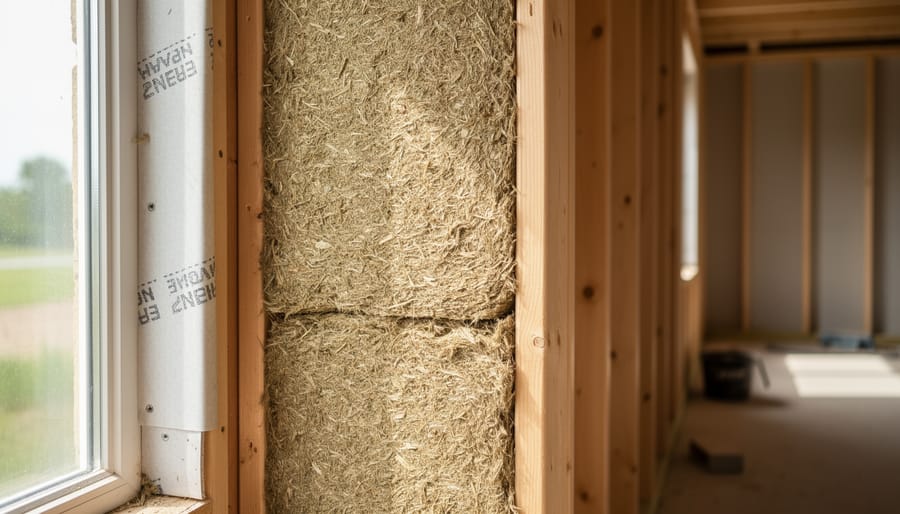
While walls and finishes capture attention, the materials concealed within them shape daily experience. Hemp insulation batts and boards represent an infrastructure decision that aligns thermal performance with the values driving luxury home design in 2026. Unlike synthetic alternatives, hemp insulation delivers measurable comfort improvements while maintaining the breathability essential to healthy interior environments.
Hemp insulation batts, typically bound with minimal polyester or natural starch, install between studs and joists like conventional products yet regulate moisture differently. Rather than trapping vapor and risking condensation, hemp fibers absorb and release humidity without losing thermal efficiency. This creates more stable interior conditions year-round, reducing the temperature fluctuations and stuffiness common in tightly sealed homes. For bedrooms especially, this contributes to the stable environment associated with better sleep products and wellness-focused design.
| Material | R-Value per inch | Breathability | Embodied Carbon |
|---|---|---|---|
| Hemp Batts | R-3.5-3.7 | Excellent | Negative (carbon storing) |
| Fiberglass | R-3.1-3.4 | Poor | High |
| Mineral Wool | R-3.3-4.2 | Moderate | Very high |
| Cellulose | R-3.2-3.8 | Good | Low |
Acoustic performance further distinguishes hemp. Its dense fiber structure absorbs sound across a broader frequency range than fiberglass, reducing both airborne noise between rooms and impact sounds from floors. In open-plan homes where sound management determines livability, hemp insulation creates the quiet backdrop luxury occupants expect without requiring additional acoustic layers.
The cost premium over fiberglass remains modest, typically fifteen to twenty-five percent, positioning hemp as accessible infrastructure rather than indulgence. Architects specify it not for visible impact but for the cumulative effect on comfort, air quality, and environmental footprint across decades of occupancy.
Hemp-Based Finishes: Textiles, Wallcoverings, and Surface Materials
Global Artisan Collaborations
The Japanese studio Boro Textiles has revived traditional tsumugi techniques with hemp fiber, creating wall hangings where irregular weave patterns produce subtle variations in opacity, ideal for light-filtering room dividers in minimalist interiors. Designer Akiko Matsumoto pairs raw hemp with indigo fermentation, yielding surfaces that deepen in color over years of exposure, embodying the wabi-sabi philosophy of materials that improve with age.
In the Netherlands, Studio Nienke Hoogvliet transforms hemp fiber waste from textile production into sculptural wall panels through a wet-felting process. Her installations for private residences layer pigmented hemp pulp to create gradient surfaces that shift from ivory to charcoal, demonstrating how industrial byproducts can become bespoke finishes.
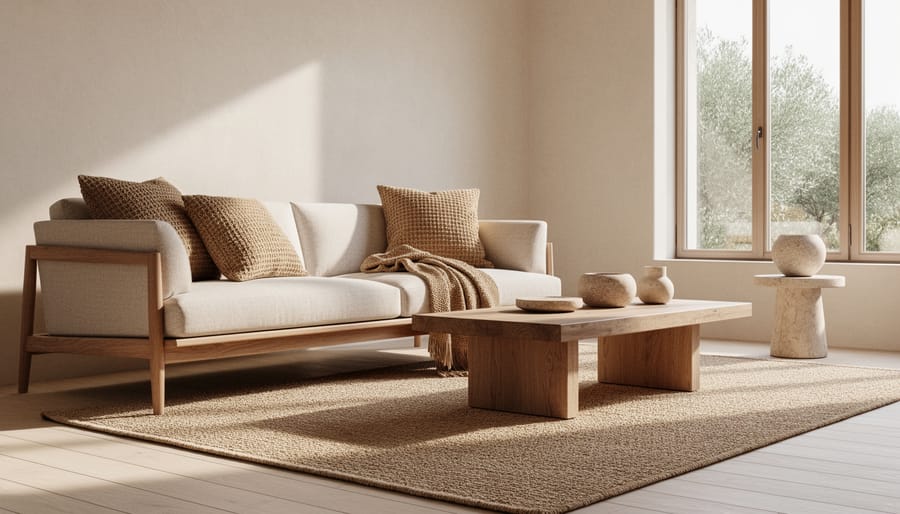
Swiss collective Atelier Pfister collaborates with Alpine hemp farmers to produce architectural felts. These dense, needle-punched panels function as both acoustic absorbers and textural backdrops, their natural beige tones serving as neutral canvases in gallery-like residential spaces. The collective’s work bridges agricultural tradition with contemporary craft, positioning hemp as heritage material reimagined for present sensibilities.
The Sustainability Narrative: Carbon-Negative Design
Hemp’s environmental credentials extend far beyond typical sustainable materials, they represent a fundamental reimagining of how buildings interact with atmospheric carbon. Unlike conventional construction materials that release greenhouse gases during production, hemp-based products actively sequester carbon throughout the plant’s rapid four-month growth cycle. Industrial hemp captures approximately 1.63 tonnes of CO₂ per tonne of dry stem material, effectively transforming interiors into carbon sinks that offset emissions for decades.
This carbon-negative profile stems from hemp’s biological architecture. As the plant grows, it absorbs atmospheric carbon and locks it into cellulose fibers. When processed into hempcrete, insulation, or fiber panels without high-temperature treatments, this carbon remains captured within your walls, potentially for the structure’s entire lifespan. A hempcrete wall in a luxury residence continues sequestering carbon even after installation as the lime binder undergoes carbonation, gradually hardening while drawing additional CO₂ from the air.
The circular economy dimension adds another layer of sophistication to hemp’s environmental story. Hemp materials are biodegradable at end-of-life, avoiding the landfill burden of synthetic insulations or composite panels. When a hemp-insulated wall is deconstructed, the material can be composted or repurposed without releasing toxins, a stark contrast to foam insulations requiring specialized disposal.
For homeowners seeking substance behind sustainability claims, hemp offers verifiable lifecycle benefits: minimal processing energy, regional cultivation potential that reduces transportation impacts, and natural pest resistance that eliminates chemical treatments during growth. These aren’t marketing narratives but measurable advantages that align environmental responsibility with the uncompromising standards expected in contemporary luxury design.
Navigating Regulations and Sourcing in 2026
The regulatory landscape for hemp building materials has matured considerably, though regional variations remain significant. In North America and the European Union, industrial hemp cultivation and processing regulations have stabilized following decades of incremental legalization, yet building code acceptance lags behind agricultural policy. Most jurisdictions still classify hempcrete and hemp fiber products as “alternative building systems,” requiring case-by-case approval rather than automatic compliance with prescriptive codes. Designers working with these materials should anticipate submitting technical data sheets, third-party testing reports, and often engineer-stamped drawings to satisfy local building officials unfamiliar with plant-based construction methods.
Sourcing strategies have evolved as supply chains mature. European manufacturers, particularly in France, the Netherlands, and Germany, offer the most established product lines with consistent quality and comprehensive technical support. North American suppliers have expanded rapidly since 2024, though product availability varies by region and lead times can extend to twelve weeks for specialty items. Architects and designers benefit from establishing relationships with dedicated natural building material distributors rather than attempting to source through conventional construction suppliers, who rarely stock hemp products or understand their specifications.
For projects referencing a sustainable design precedent in institutional or commercial contexts, code approval becomes more streamlined as officials recognize established case studies. Residential applications face greater scrutiny in conservative building jurisdictions, where demonstrating equivalency to prescriptive code requirements demands patience and documentation. The most successful projects involve early consultation with building officials, presentation of international performance data, and engagement of engineers familiar with natural materials to provide the technical validation that reassures regulators and contractors alike.
Designing with Hemp: Aesthetic and Technical Considerations
Hemp materials demand a compositional approach that honors their inherent texture while maintaining the polish expected in luxury interiors. The key lies in contrast: set hemp’s organic roughness against refined surfaces, polished concrete floors, brushed steel fixtures, or honed marble countertops. This juxtaposition prevents spaces from reading as overly rustic while celebrating the material’s tactile authenticity.
Light transforms hemp-based surfaces throughout the day. Hempcrete walls catch and diffuse natural light beautifully, their subtle variations in tone creating depth that flat, industrial materials cannot match. Position them where morning or afternoon sun can graze the surface, emphasizing texture. In rooms with limited daylight, warm LED strips or recessed lighting at grazing angles achieve similar effects without the harshness of direct overhead illumination.
Color palettes should acknowledge hemp’s natural spectrum, cream, taupe, warm gray, rather than fight it. Neutrals ranging from chalk white to charcoal provide cohesion, while strategic color accents in furnishings or art prevent monotony. Jewel tones like emerald or sapphire create striking moments against hemp’s earthiness. Avoid competing warm yellows or beiges that muddy the palette.
Complementary materials require thoughtful selection. Natural woods, particularly those with visible grain like white oak or walnut, share hemp’s organic sensibility. Glass and metal introduce necessary precision. Linen upholstery and wool textiles echo hemp’s fiber origins without redundancy. Stone, whether limestone, travertine, or slate, bridges the natural-refined divide effectively.
Spatial application matters enormously. Hemp materials excel in spaces where their thermal mass and acoustic properties enhance comfort: bedrooms, libraries, meditation rooms. They perform less well in high-moisture environments without proper detailing and fire safety considerations in compliance with local codes. Consider hemp as a primary wall treatment in select rooms rather than attempting whole-home application, which can overwhelm even generous budgets and patience during construction.
Hemp-based building materials represent a profound convergence, where ancient agricultural wisdom meets cutting-edge material science, where environmental imperative aligns with aesthetic aspiration. As we’ve explored throughout this journey, hemp offers discerning homeowners and design professionals far more than a sustainable alternative. It provides a design language rich with texture, warmth, and authenticity.
The materials we choose for our interiors communicate values. Hemp speaks to a sophisticated understanding that true luxury no longer demands extraction and excess. Instead, it embraces regeneration and restraint. Whether expressed through the raw, sculptural presence of hempcrete walls or the refined elegance of hemp fiber textiles, these materials bring depth and character that synthetic alternatives cannot replicate.
Looking forward, hemp’s role in residential architecture will likely expand as supply chains mature and design literacy grows. We’re witnessing the early chapters of a material renaissance, one that honors craft traditions while pushing technical boundaries. Hemp works beautifully within diverse aesthetic frameworks, from minimalist interior design emphasizing material honesty to maximalist spaces celebrating textural layering.
For those ready to explore hemp’s possibilities, the invitation is clear: consider these materials not just as building components, but as design statements that connect your home to broader narratives of innovation, heritage, and planetary stewardship. The question isn’t whether hemp belongs in luxury interiors, it’s how you’ll make it distinctly yours.