

Research peptides are bioactive chains of amino acids sold for laboratory and investigative purposes, available through specialized suppliers like Kylo Peptides and similar vendors who cater to institutions, researchers, and increasingly, the design-forward innovators reimagining domestic spaces. These compounds, once confined to pharmaceutical labs and university research centers, now intersect with the architecture of wellness at home, informing everything from circadian lighting systems to bio-responsive materials that adapt to human biology in real time.
The peptides themselves function as molecular signals, precise instructions that influence cellular behavior. When purchased for research, they open pathways to understanding how biological systems respond to environmental cues, a dialogue that translates directly into the high-performance homes of 2026. Architects and interior designers collaborate with material scientists to embed peptide-informed principles into wall finishes that regulate humidity or air purification systems calibrated to support human vitality at the molecular level.
Buying research peptides requires discernment. Quality hinges on purity certification, third-party testing, and transparent sourcing, considerations familiar to anyone commissioning bespoke finishes or sourcing rare materials for a project. The compounds must arrive with documented provenance, much like a statement piece from a global atelier. As peptide research advances, its influence ripples beyond the laboratory, shaping interiors where biology and design converge, where the unseen architecture of human health becomes as meticulously curated as the visible structures we inhabit.
Understanding Research Peptides: Bridging Science and Design

Scientific Foundations of Research Peptides
Peptides are short chains of amino acids, typically between two and fifty units, that serve as fundamental building blocks within biological systems. Unlike proteins, which can contain hundreds or thousands of amino acids folded into complex structures, peptides occupy an intriguing middle ground: large enough to perform specific biological functions, yet small enough to be synthesized precisely in laboratory settings.
In research environments, these molecules act as powerful tools for investigating cellular processes, hormone signaling, and immune responses. Scientists purchase peptides to study everything from metabolic pathways to tissue regeneration, replicating naturally occurring sequences or designing novel variants to test hypotheses. Their availability for purchase democratizes cutting-edge inquiry, allowing institutions worldwide to explore therapeutic possibilities, map biological mechanisms, and develop biomaterials.
What makes peptides particularly compelling is their structural elegance, predictable yet remarkably versatile. This duality has captured the attention of material scientists and designers who recognize that nature’s efficient molecular architecture might inform surfaces, coatings, and textiles with unprecedented functionality.
Synergy with Design Thinking
The conversation between molecular biology and spatial design has intensified as architects and interior creators recognize that nature’s most elegant solutions often operate at scales invisible to the naked eye. Peptides, short chains of amino acids, exemplify efficiency: they fold into precise geometries, assemble into larger structures, and respond dynamically to their environments. These same principles now inform how designers approach adaptive spaces, modular systems, and responsive materials.
Where traditional design thinking emphasizes human-centered problem solving, this synthesis looks deeper, drawing from biological logic that has evolved over millennia. A peptide’s ability to self-organize mirrors contemporary desires for homes that adapt without intrusive mechanics. Its structural economy resonates with minimalist aesthetics. Leading studios increasingly collaborate with biochemists, not to mimic forms superficially, but to understand underlying processes, how binding occurs, how stability emerges from flexibility, how complexity arises from simple rules. This interdisciplinary exchange yields interiors that feel intuitively alive, materials that interact subtly with occupants, and architectural vocabularies rooted in something more fundamental than trend.
Materials Revolution: Peptide-Driven Innovations in Home Design
From Lab to Living Room: Translating Science into Everyday Elegance
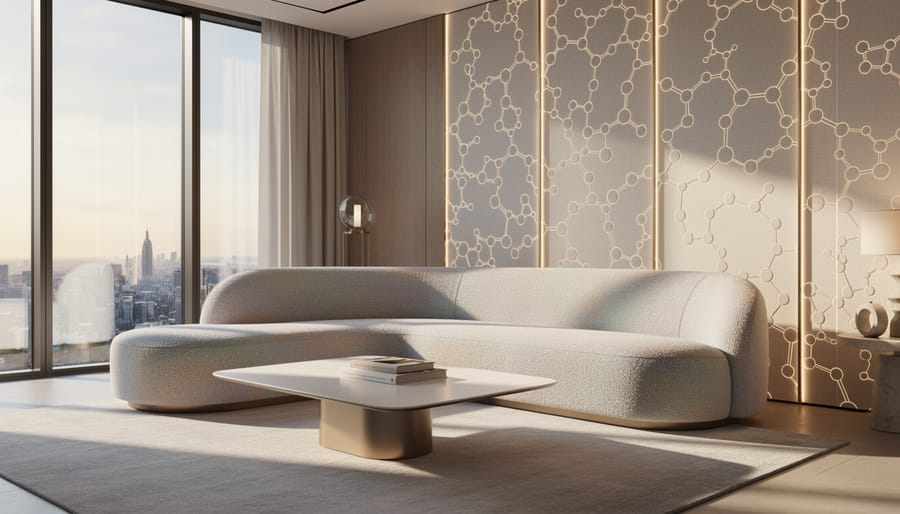
The journey from laboratory bench to polished interior is no longer purely metaphorical. Peptide research has seeded a generation of materials that marry scientific rigor with aesthetic refinement. Consider antimicrobial wall panels that employ peptide-derived coatings to neutralize pathogens on contact, a concept initially explored in clinical settings and now reimagined for residential wellness. These surfaces do not merely resist bacteria; they actively dismantle contaminants, offering peace of mind without compromising visual purity. In bedrooms, where air quality and hygiene directly influence a night’s sleep such innovations speak to a deeper care embedded within architecture itself.
Responsive textiles have followed a similar trajectory. Drawing on peptide structures that shift behavior in response to environmental cues, designers now craft upholstery and drapes that regulate temperature, repel moisture, or subtly change texture as light and humidity fluctuate. Self-healing finishes, inspired by the regenerative properties of biological peptides, allow furniture and flooring to recover from minor scratches autonomously, preserving the integrity of handcrafted surfaces over decades. These advances do not merely solve practical problems; they elevate everyday experience into something quietly extraordinary. The same principles that once helped public spaces reopen safely now enrich private sanctuaries, translating lab-born insight into domestic grace.
Sustainability and Sensory Luxury
Modern consumers increasingly seek environments that honor both the planet and the senses, a desire that peptide-inspired materials answer with remarkable sophistication. These biologically derived compounds inform the creation of surfaces and textiles that minimize environmental impact while delivering tactile richness and visual nuance previously unattainable through conventional manufacturing. Unlike synthetic finishes that rely on petroleum-based processes, peptide-guided design draws from nature’s own assembly methods, yielding materials that biodegrade gracefully and reduce chemical footprints without sacrificing aesthetic refinement.
The sensory dimension proves equally compelling. Peptide-based coatings offer subtle luminosity that shifts with light, while bio-integrated textiles respond to touch and temperature with a quiet intelligence. This marriage of ecological responsibility and experiential depth speaks to a global movement toward homes that feel both deeply personal and culturally resonant, spaces where every element tells a story of thoughtful stewardship. As research into these compounds advances, the boundary between sustainable material and sensory indulgence dissolves, revealing design possibilities that honor tradition while embracing scientific progress. The result transforms luxury from mere opulence into something more enduring: environments that nourish both inhabitants and the world beyond their walls.
Navigating the Marketplace: Ethical Considerations and Sourcing Research Peptides
Legal and Cultural Frameworks
The regulatory landscape governing research peptides varies dramatically across continents, creating a patchwork of permissions and restrictions that designers must navigate. In North America and the European Union, peptides sold for research purposes occupy a defined legal category, permitted for laboratory study but strictly prohibited for human consumption or direct therapeutic application. Japan enforces similarly rigorous standards, yet its scientific culture has long embraced biomimetic principles, informing how architects approach material selection in Japanese minimalist design. As peptide-derived materials transition from research to commercial application in home products, antimicrobial coatings, responsive textiles, bio-integrated surfaces, manufacturers face evolving certification requirements that demand transparency about sourcing, purity, and intended use. These frameworks protect consumers while allowing innovation to flourish within clear boundaries.
Selecting Trusted Sources
Selecting reliable suppliers for research peptides requires careful scrutiny. Reputable vendors will clearly disclose third-party lab testing results, providing certificates of analysis that verify purity levels, molecular structure, and absence of contaminants. Seek documentation for each peptide batch, not just generic testimonials. High-end projects often demand peptides at 95% purity or above; substandard sources risk introducing variables that compromise scientific and design outcomes alike. Prioritize vendors with transparent ethical sourcing policies and compliance with local and international regulations. Evaluate customer support and after-sale transparency, as these reflect a long-term commitment to integrity. Trusted partners help ensure that integrating research peptides into design not only advances innovation but also upholds the standards that shape responsible, forward-looking environments.
Responsible Use in Design
Scientific ingenuity brings fresh potential to the home, but introducing materials derived from research peptides demands careful stewardship. Designers must not only honor safety protocols and safeguard privacy, but also reflect on the social footprint of their choices. The allure of biologically inspired innovations can tempt haste, yet responsible use means examining downstream effects, are these materials truly safe for daily exposure, and are they sourced with full ethical transparency? Weaving research peptides into high-end interiors elevates sensory experiences, but lasting value arises from innovation pursued with a conscious regard for community well-being, cultural context, and long-term ecological impact.
Global Inspirations: Cultural Narratives and the Peptide Aesthetic
Bio-Mimicry Across Cultures
For millennia, cultures worldwide have looked to nature’s smallest building blocks for architectural inspiration. Japanese temple joinery echoes protein folding’s precise geometry, while Islamic tessellations mirror the repetitive patterns found in amino acid chains. Today’s peptide research reveals what artisans intuitively understood: nature’s molecular architecture offers blueprints for structural integrity and visual harmony.
Contemporary designers like Heatherwick Studio translate these biological principles into built form, creating facades that breathe and interiors that adapt. Indigenous Australian dot paintings capture the same interconnectedness scientists observe in peptide networks, where individual elements gain strength through deliberate arrangement. Scandinavian minimalism’s restraint reflects peptide efficiency, maximum impact from minimal components.
This cross-cultural resonance isn’t coincidental. Peptide-inspired design taps into universal patterns that transcend geography, marrying ancestral wisdom with molecular precision to create homes that feel both ancient and radically new.
A New Visual Language
The aesthetic vocabulary of peptide structures, helical curves, delicate lattices, the shimmer of folded chains, offers designers a visual repertoire unlike anything in traditional ornament. These microscopic forms possess an inherent elegance: fractal-like repetition, asymmetrical balance, and a play of light that shifts with perspective. When translated into wall coverings, lighting fixtures, or furniture silhouettes, they introduce a quietly dramatic presence that feels both ancient and entirely modern.
Consider how a chandelier inspired by peptide bonding patterns casts shadows that ripple organically across a ceiling, or how textiles woven to echo amino acid sequences create depth through subtle tonal variation rather than bold color. This is design that rewards sustained attention, patterns reveal themselves slowly, inviting contemplation rather than demanding it.
Luxury interiors increasingly favor this restrained complexity over overt statement pieces. The peptide aesthetic speaks to clients who appreciate refinement grounded in natural logic, where beauty emerges from structure itself. It’s ornamentation that carries intellectual weight, transforming scientific precision into lived poetry.
Envisioning the Future: Home Innovation Through a Scientific Lens
Next-Gen Sensory Environments
Peptide-driven materials promise a future where domestic environments respond as intuitively as living organisms. Imagine walls that modulate texture or color in response to ambient light, or textiles that adjust temperature according to a room’s occupancy, each made possible by the molecular adaptability of bio-inspired designs. The influence of research peptides for sale extends to olfactory and acoustic design, inspiring surfaces that filter air or dampen noise much like biological membranes. This integration of sensory sensitivity and adaptive function infuses homes with a subtle energy, allowing spaces to gently evolve with their inhabitants and the rhythms of daily life, while upholding a commitment to ecological balance and aesthetic sophistication.

The Designer-Scientist Dialogue
The future of home innovation depends on fostering genuine partnerships between designers and scientists, a convergence that transcends superficial borrowing of imagery. When researchers studying peptides share their findings with architects and material specialists, novel possibilities emerge that neither discipline could achieve alone. This dialogue transforms abstract molecular behavior into tangible design principles: a peptide’s tendency to self-organize might inspire a modular furniture system, while its responsive nature could inform climate-adaptive facades.
Leading design studios now employ scientific advisors, while research institutions invite designers into laboratories to witness peptide synthesis firsthand. These collaborations yield more than aesthetic choices; they create functional breakthroughs rooted in biological logic. The exchange demands fluency in each other’s languages, scientists learning to articulate beyond data, designers understanding the constraints of molecular engineering.
As peptide research advances, maintaining this reciprocal conversation ensures that homes evolve not merely through technological novelty, but through thoughtful integration of nature’s sophisticated systems into spaces where humans thrive.
The convergence of peptide science and home design represents more than a fleeting trend. It signals a fundamental shift in how we conceive living spaces, moving beyond static aesthetics toward environments that respond, adapt, and harmonize with human biology. Throughout this exploration, we’ve traced peptides from laboratory benches to living rooms, witnessing their quiet influence on materials that heal themselves, surfaces that protect occupants, and textiles that shift with our needs.
This intersection invites us to reconsider what luxury means in contemporary architecture. True sophistication now emerges not from ornamentation alone, but from intelligent integration of scientific insight with design sensibility. The biomolecular structures that fascinate researchers inspire visual languages rich with organic complexity, while ethical sourcing considerations remind us that innovation carries responsibility.
As designers and architects continue dialoguing with scientists, homes will increasingly embody principles drawn from nature’s smallest building blocks. The peptide aesthetic points toward a future where walls breathe, surfaces think, and spaces evolve. For those drawn to homes as expressions of both artistry and thoughtful progress, this realm offers abundant inspiration. The journey from understanding research peptides for sale to envisioning their impact on our most intimate environments has only just begun.