Bathroom transformations in 2026 range from $8,000 for a budget refresh to well over $85,000 for a luxury reimagining, with most mid-range renovations settling between $25,000 and $45,000. These figures reflect more than square footage and fixture selection. They capture divergent design philosophies, material provenance, labor expertise, and the architectural ambition driving each project.
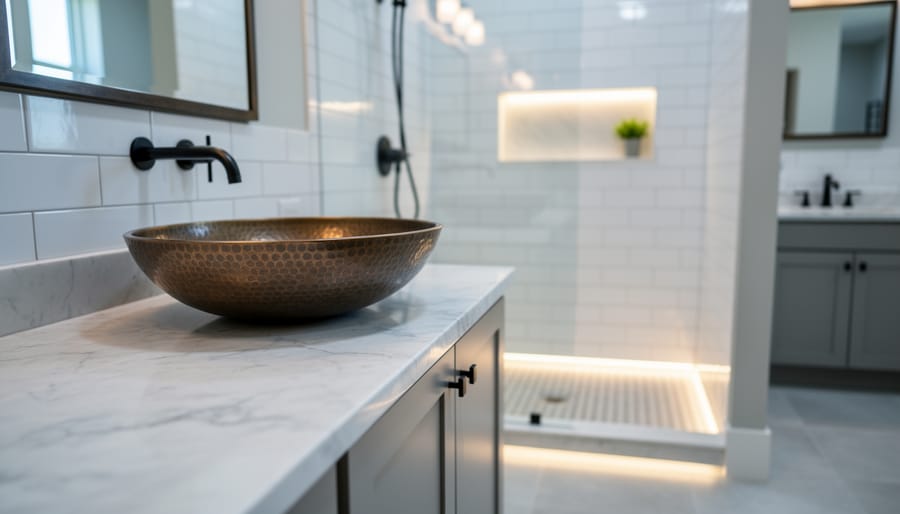
The gap between a modest update and a statement-making space hinges on several decisive factors: structural modifications that require permits and engineering oversight, custom millwork versus prefabricated cabinetry, tile origin and installation complexity, plumbing relocations, and whether you commission bespoke lighting or select catalog pieces. A powder room clad in honed Calacatta marble with radiant floor heating and a hand-hammered bronze sink occupies an entirely different cost universe than one finished with ceramic subway tile and stock vanity components, even when both achieve visual coherence.
Understanding these cost tiers requires more than averages. It demands narrative context. What does $12,000 actually procure in a compact urban condo bath influenced by Japanese minimalism? How does a $38,000 mid-century modern renovation in Portland allocate resources between vintage-inspired fixtures and structural work? And what distinguishes an $87,000 spa-inspired sanctuary beyond the price tag itself?
This article presents three fully realized bathroom transformations, each documented with transparent cost breakdowns, design decisions, and the cultural-architectural threads that shaped them. If you need comprehensive budget planning before exploring these case studies, see the full cost breakdown for current pricing across all project types.
Three Bathroom Transformations at a Glance
The three bathroom transformations featured in this article represent distinct points on the renovation spectrum, each shaped by different spatial constraints, design philosophies, and investment levels. Together, they illuminate the relationship between vision and budget, demonstrating that compelling design emerges from clarity of purpose rather than expenditure alone.
The first project, a compact urban powder room in a Brooklyn loft, occupies just 35 square feet yet delivers outsized visual impact. The homeowners, a young creative couple, pursued a minimalist Scandinavian aesthetic through strategic material choices and selective DIY contributions. Completed over four weeks in early 2026, this transformation required $8,500, proof that disciplined editing and thoughtful sourcing can yield sophisticated results within tight spatial and financial parameters.
| Project Name | Square Footage | Design Style | Timeline | Total Cost |
|---|---|---|---|---|
| Urban Powder Room | 35 sq ft | Minimalist Scandinavian | 4 weeks | $8,500 |
| Mid-Century Family Bath | 75 sq ft | California Modernism | 6 weeks | $28,000 |
| Primary Suite Retreat | 180 sq ft | Japanese-Scandinavian Fusion | 10 weeks | $87,000 |
The second transformation centers on a 75-square-foot hall bathroom in a 1960s Pasadena residence. A family of four sought to honor the home’s original mid-century character while addressing decades of deferred maintenance and improving daily functionality. Custom walnut cabinetry, period-appropriate fixtures, and preserved terrazzo flooring define this project, which spanned six weeks and cost $28,000. The investment reflects a deliberate balance between architectural integrity and contemporary performance standards.
The third project, a 180-square-foot primary bathroom in a Malibu coastal home, embodies experiential luxury. The homeowners envisioned a wellness sanctuary synthesizing Japanese wabi-sabi principles with Scandinavian restraint, incorporating radiant heating, hand-selected limestone, and a soaking tub sourced from Kyoto. Completed over ten weeks at a cost of $87,000, this transformation illustrates how specialized craftsmanship and globally-sourced materials elevate a utilitarian space into a meditative retreat.
Project One: The Budget-Conscious Urban Powder Room
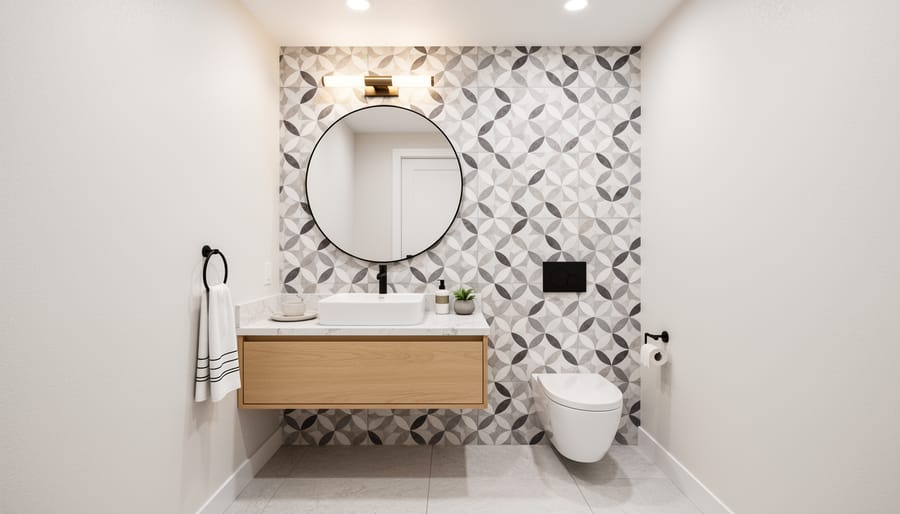
Design Vision and Material Selections
The homeowner, a graphic designer working from their 900-square-foot loft, approached this powder room as an exercise in restraint and curation rather than wholesale replacement. The existing pedestal sink and toilet remained structurally sound; instead of discarding them, both received professional refinishing, a process involving chemical stripping and powder-coat reapplication that renewed their appearance for a fraction of replacement cost.
The transformative gesture came through a single accent wall clad in handmade Moroccan zellige tile in muted sage, its irregular surface catching light throughout the day. Opposing walls received two coats of Benjamin Moore’s “Revere Pewter,” a warm greige that unified the compact space without visual weight. A vintage French brass sconce, sourced from a local architectural salvage dealer, replaced builder-grade lighting and established an artisanal focal point.
Chrome hardware gave way to unlacquered brass cabinet pulls and towel bars that would patina naturally, a deliberate nod to wabi-sabi philosophy. The approach prioritized character-rich elements that telegraphed intentionality: each piece selected for aesthetic contribution rather than accumulation, creating a cohesive micro-environment that felt considered rather than assembled from catalog defaults.
Cost Breakdown: Where the Money Went
The $8,500 transformation broke down into five strategic allocation categories, each reflecting deliberate choices about where to invest and where to economize. The homeowner’s spreadsheet, maintained throughout the project, revealed a clear hierarchy: prioritize what visitors see and touch first, streamline structural work, and accept longer lead times for vintage finds.
- Fixtures and hardware: $1,200 (wall-mounted sink, vintage brass faucet, refurbished mirror frame, cabinet pulls)
- Tile and surface materials: $2,100 (handmade zellige tile for accent wall, porcelain floor tile, grout, adhesive, backer board)
- Professional labor: $3,800 (licensed plumber for rough-in work, tile setter for installation, electrician for lighting)
- Lighting elements: $900 (restored 1940s sconce pair, LED mirror strip, dimmer switch, installation hardware)
- Finishing touches: $500 (Benjamin Moore paint, custom shelf, textiles, plants, styling accessories)
The fixture budget stretched furthest through patience and resourcefulness. Rather than purchasing a new pedestal sink at $800, the homeowner sourced a slender wall-hung basin from an architectural salvage dealer for $280, then allocated savings toward a restored brass faucet that delivered the warm metallic accent the space demanded. The mirror frame, originally destined for replacement, received careful restoration and new silvering for $140 instead.
Tile represented the single largest material investment, but the homeowner confined handmade zellige to one dramatic accent wall rather than wrapping the entire room, reducing square footage needs by 60 percent. Standard white porcelain covered the floor at $3.50 per square foot, allowing the artisan wall tile to command attention without overwhelming the budget. Labor costs reflected non-negotiable professional requirements: moving plumbing lines and ensuring waterproofing integrity demanded licensed expertise, while the homeowner handled demolition, priming, and final styling independently.
DIY Contributions and Professional Support
The powder room’s $8,500 final cost reflected a strategic division of labor that played to the homeowner’s strengths while acknowledging professional necessity. Emma, a graphic designer with weekend carpentry skills, tackled demolition herself over two days, removing the builder-grade vanity, mirror, and outdated light fixture, saving approximately $800 in contractor fees. She also handled all painting, applying three coats of Benjamin Moore’s “Dove Wing” to achieve the smooth, Nordic-inspired backdrop central to her vision.
Professional intervention proved non-negotiable for plumbing and tile work. A licensed plumber spent six hours relocating supply lines and installing the wall-mounted faucet, ensuring code compliance and leak-free performance, work that would have been impossible without specialized tools and permits. Similarly, the geometric floor tile installation required a tile setter’s precision; Emma’s initial attempt at a dry layout revealed how quickly lippage and grout-line inconsistencies destroy a design’s integrity.
Total DIY time investment: thirty-two hours across three weekends. The hybrid approach reduced labor costs by roughly 35 percent while maintaining quality where it mattered most, demonstrating that strategic self-reliance amplifies budget without compromising craftsmanship.
Project Two: The Mid-Century Modern Family Bathroom
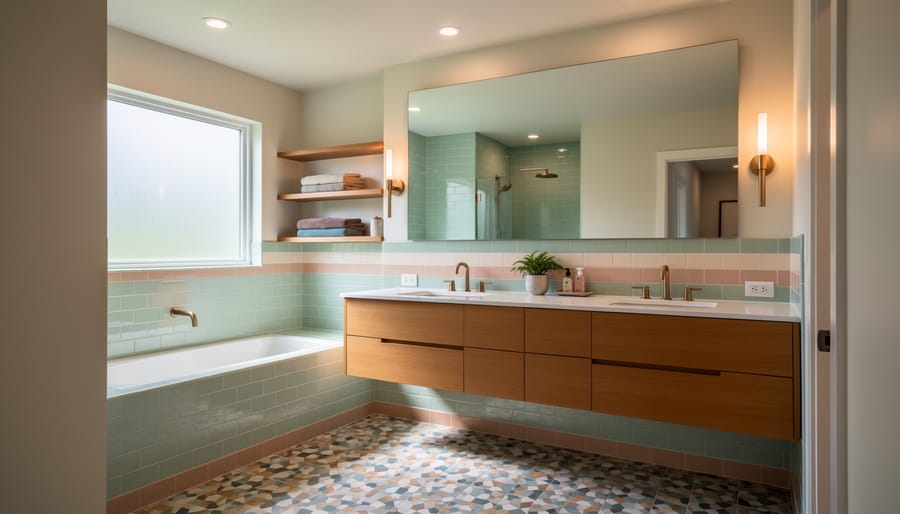
Preserving Architectural Integrity While Modernizing
The homeowners acquired their 1962 Eichler-inspired tract home precisely for its architectural bones, post-and-beam construction, clerestory windows, and original pink-hued terrazzo floors that had survived decades of foot traffic with minimal wear. Rather than rip out these period elements, the renovation strategy centered on honoring them while addressing functional shortcomings: a cramped vanity area, dated chrome fixtures showing corrosion, and inadequate storage for a family of four.
The terrazzo remained untouched save for professional grinding and sealing, its subtle aggregate pattern providing textural warmth against new surfaces. Plumbing fixtures were replaced with brushed brass pieces from a specialty manufacturer producing authenticated mid-century replicas, wall-mounted faucets with cross handles, a period-correct tub filler, that read as original yet met contemporary water efficiency standards. A local craftsman fabricated the walnut floating vanity, its horizontal grain and tapered legs echoing Nakashima’s organic modernism while concealing soft-close drawers and integrated electrical outlets for home wellness upgrades like sonic toothbrushes and skincare devices.
Layout reconfiguration involved removing a linen closet to expand the shower footprint and relocating the toilet eighteen inches, creating better circulation without altering the room’s original footprint or compromising the exterior wall’s glazing rhythm, a move that required precision plumbing but preserved the spatial logic that defined California modernism’s indoor-outdoor fluidity.
Cost Breakdown: Investment in Quality and Craft
The $28,000 investment in this mid-century modern family bathroom reflects a deliberate commitment to materials and workmanship that honor the home’s architectural heritage while serving contemporary needs. The renovation preserved the space’s original character through careful selection and skilled execution.
| Category | Description | Cost |
|---|---|---|
| Custom Cabinetry | Walnut vanity and medicine cabinet by local millworker | $7,500 |
| Plumbing Fixtures | Period-appropriate tub, toilet, faucets in brushed brass | $4,200 |
| Tile and Stone Work | Handmade ceramic wall tile, terrazzo restoration, grout | $5,800 |
| Labor | General contractor, plumber, tile setter, electrician | $8,000 |
| Lighting and Mirrors | Vintage-style sconces, custom mirror, dimmer controls | $1,500 |
| Permitting and Design | Municipal permits, design consultation | $1,000 |
The custom walnut cabinetry commanded the largest single line item, yet delivered irreplaceable value. Unlike factory-built vanities, the bespoke millwork accommodated the room’s irregular dimensions and integrated storage solutions tailored to the family’s routines. The grain-matched drawer fronts and hand-rubbed oil finish exemplify a level of craft absent from mass production.
Tile and stone work consumed $5,800, with half allocated to artisan-made ceramic tile that echoed 1960s California modernism through irregular glazing and hand-formed edges. The remaining budget restored the existing terrazzo flooring, grinding and resealing the surface to reveal its original aggregate beauty. This approach preserved historical authenticity while avoiding the $12,000+ cost of replacement.
Labor expenses reflect coordination among specialized trades, licensed plumber for fixture installation, experienced tile setter for precision layout, electrician for code-compliant wiring. Permitting costs remained modest compared to NYC permit fees though still necessary for legal compliance. The family recognized that spaces designed for both daily function and sleep and comfort require professional expertise that justifies the investment.
Professional Team and Timeline Considerations
The mid-century bathroom renovation required orchestrating three specialized trades over a compressed six-week timeline. The general contractor served as project manager, coordinating the tile specialist who installed the terrazzo-look ceramic and custom shower surround, and the cabinetmaker who fabricated and installed the walnut vanity. This sequencing proved critical: plumbing rough-in preceded tile work, which had to cure before the vanity could be templated and mounted.
Each tradesperson brought irreplaceable expertise. The tile setter’s experience with period-appropriate materials ensured historically accurate installations, while the cabinetmaker’s millwork skills delivered seamless joinery that honored the home’s original craftsmanship. The contractor’s scheduling prevented costly delays, ordering the custom vanity early allowed fabrication to occur during demolition and rough plumbing phases.
Professional management added $2,000 to the budget but prevented the cascade failures common in DIY-coordinated projects: missed inspections, material delivery conflicts, and sequencing errors that force rework. For a family bathroom serving daily routines, minimizing downtime justified the coordination premium. The six-week window, ambitious for this scope, succeeded only through disciplined scheduling and trade expertise.
Project Three: The Spa-Inspired Primary Suite Retreat
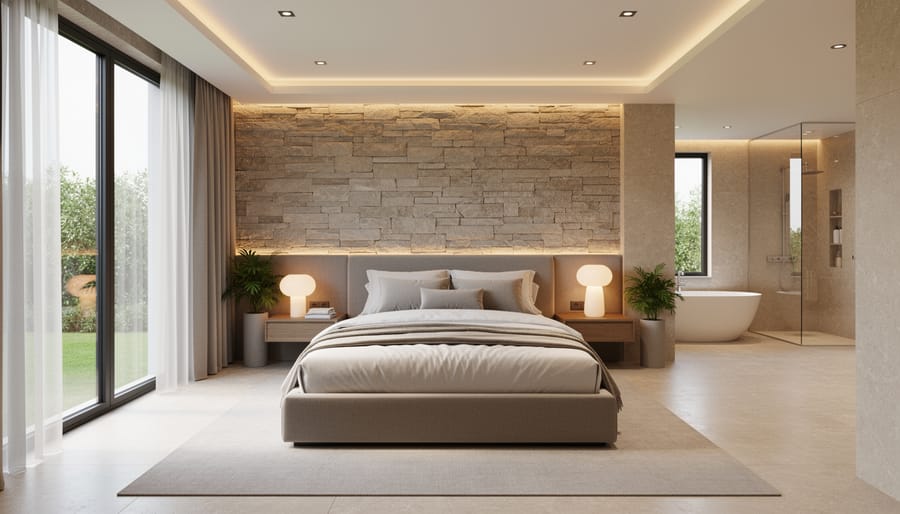
Design Philosophy: East Meets West
The homeowners envisioned a sanctuary where material honesty and spatial restraint would create calm rather than ostentation. They drew from wabi-sabi’s embrace of imperfection and impermanence, selecting honed limestone with natural fossil inclusions and commissioning handmade ceramic tile whose glaze variations told a story of the artisan’s hand. The teak flooring, left unvarnished to patina over time, embodied this philosophy of graceful aging.
Japanese minimalist design informed the spatial choreography: a freestanding soaking tub positioned to face a frosted-glass garden wall, eliminating visual clutter while framing natural light. Scandinavian minimalism contributed functional warmth through clean-lined cabinetry and understated hardware. California’s indoor-outdoor ethos manifested in the seamless threshold between bathing space and private courtyard, where sliding glass panels dissolved boundaries.
The palette remained deliberately narrow, warm grey stone, honey-toned wood, matte black accents, allowing texture and light to provide variation. This restraint required precise detailing: flush tile transitions, concealed drains, shadow gaps around millwork. The resulting space feels both ancient and contemporary, a meditation on essential elements refined to their purest expression.
Cost Breakdown: Luxury Materials and Precision Craftsmanship
The $87,000 investment in this coastal sanctuary divided into eight major expenditure categories, each reflecting a deliberate choice to prioritize enduring quality and artisan craftsmanship over mass-market alternatives:
- Custom vanity and millwork: $16,000 for teak cabinetry fabricated by a local woodworker, including hand-rubbed oil finish and integrated drawer organizers
- Stone and tile: $18,500 covering imported Turkish limestone slabs, Japanese ceramic field tile, and fabrication fees for waterfall-edge countertops
- Freestanding soaking tub and fixtures: $12,000 for a sculptural cast-iron tub with brushed nickel hardware and wall-mounted tub filler
- Glass enclosure and hardware: $8,000 for frameless tempered glass shower panels with minimal bronze trim and custom pivot door
- Radiant heating and ventilation: $7,500 for electric floor heating throughout and a whisper-quiet exhaust system with humidity sensors
- Lighting and controls: $6,000 including recessed LED fixtures, adjustable sconces, and a smart dimming system with preset scenes
- Labor and project management: $15,000 for general contractor oversight, tile installation, plumbing, and electrical work spanning nine weeks
- Design and architectural fees: $4,000 for spatial planning, material specifications, and construction drawings from a licensed architect
The stone and tile figure alone exceeded the entire budget of the first project, justified by the homeowner’s insistence on sustainable luxury materials sourced directly from quarries and ceramic studios rather than distributor warehouses. The limestone required three months lead time for extraction and shipping, while the handmade tile involved collaboration with a Kyoto-based artisan whose production schedule books a year ahead. Such complexity explains why luxury transformations demand not just larger budgets but patience and logistical sophistication absent from lower-tier renovations.
The Role of Specialized Tradespeople
The luxury primary bathroom’s $87,000 price tag reflects not merely materials but the orchestration of five distinct specialists, each bringing decades of mastery to their craft. The stone fabricator, who templated and installed the book-matched limestone vanity top, charged $4,200 for work that involved precision cutting, edge profiling, and field adjustments ensuring flawless seams, skills honed through years apprenticing with European stoneworkers. The tile artisan, responsible for the handmade Japanese ceramic installation, commanded $6,500 for meticulous layout, waterproofing expertise, and the patience required to work with irregular, handcrafted tiles where tolerances demand constant micro-adjustments.
The custom millworker fabricated the floating teak vanity and integrated storage using traditional joinery techniques, a three-week process justifying his $9,000 fee through furniture-grade craftsmanship that mass-produced cabinetry cannot replicate. The systems integrator programmed radiant heating controls, ventilation automation, and lighting scenes, bringing technical fluency the general contractor lacked. Finally, the design architect synthesized these elements into a cohesive spatial experience, their $4,000 fee covering conceptual vision, material specification, and coordination, the intellectual architecture underpinning every physical detail. These specialists don’t merely execute tasks; they solve problems conventional contractors encounter and abandon.
Understanding Bathroom Transformation Costs by Scale and Scope
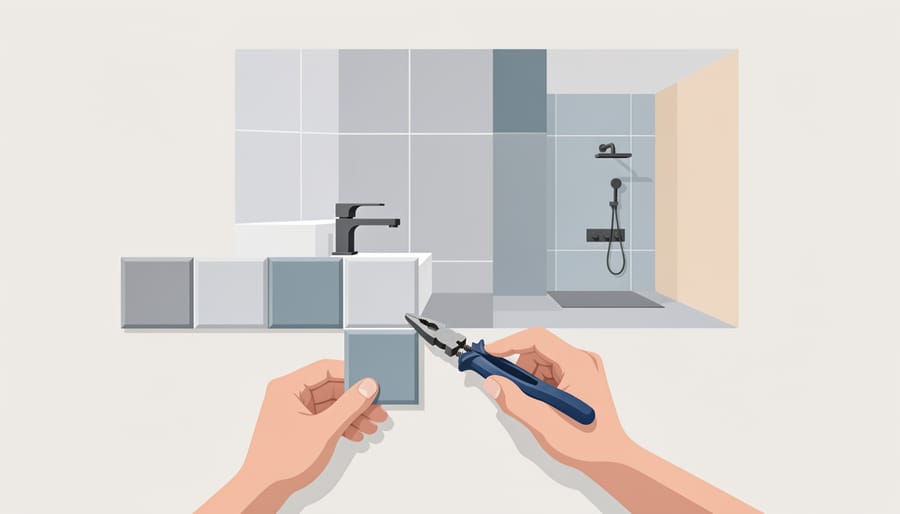
The three bathroom projects examined, powder room refresh, mid-century family bath, and spa-inspired primary suite, illustrate how renovation costs escalate in direct proportion to spatial ambition, material sophistication, and structural intervention. At the budget end, a $8,500 powder room transformation demonstrates that impactful design is achievable through selective cosmetic updates, careful material curation, and strategic DIY participation. This tier, spanning roughly $5,000 to $12,000, prioritizes surface changes over infrastructure: fresh paint, decorative tile accents, refinished or entry-level fixtures, and updated lighting. Square footage matters here, as compact spaces under 40 square feet keep material quantities manageable and labor hours contained. The urban powder room succeeded because it left plumbing lines untouched, avoided layout reconfiguration, and invested in a few artisan elements, textured tile, a vintage-style sconce, that delivered visual richness without broad material expense.
Mid-range renovations, represented by the $28,000 family bathroom, operate in a fundamentally different register. This tier spans $15,000 to $35,000 and accommodates spaces between 60 and 100 square feet where functional demands are higher and material durability becomes paramount. The California project honored existing architectural character while upgrading every surface and system: custom walnut cabinetry replaced builder-grade vanities, period-appropriate fixtures balanced authenticity with modern performance, and artisan tile work elevated everyday interactions. At this scale, homeowners invest in quality over quantity, selecting fewer but better-crafted elements, hand-glazed tile, solid wood millwork, porcelain fixtures with lifetime warranties, that justify higher unit costs through longevity and aesthetic coherence. Labor expenses also rise as projects demand skilled tradespeople rather than general contractors.
Luxury transformations beginning around $50,000 and extending well beyond, as evidenced by the $87,000 primary suite, redefine the cost conversation entirely. Square footage expands to 150 square feet or more, but spatial generosity alone does not account for the investment. Instead, these projects pursue design as narrative: custom stone fabrication, imported materials, radiant heating systems, integrated technology, and precision millwork that responds to individual use patterns. The coastal retreat featured limestone sourced from a specific Italian quarry, teak cabinetry milled to accommodate unique dimensions, and a freestanding soaking tub selected for its sculptural presence. At this tier, every element is specified rather than selected from stock, and the professional team expands to include fabricators, artisans, and design architects whose expertise commands premium fees but delivers irreplaceable results.
What Drives Bathroom Renovation Costs? Key Price Factors
Bathroom renovation costs resist simple formulas. The gulf between an $8,500 powder room refresh and an $87,000 primary suite transformation reflects not just scale, but a constellation of variables that compound unpredictably. Understanding these drivers, and their real-world manifestations, transforms budget setting from guesswork into strategic planning.
- Spatial Reconfiguration and Layout ChangesMoving walls, relocating plumbing fixtures, or altering the room’s footprint commands the steepest premiums. Shifting a toilet position requires rerouting drain lines through concrete or joists, often costing $1,200, $3,500 per fixture relocated. The mid-century family bathroom avoided this entirely by preserving its original layout, saving approximately $6,000. Conversely, the coastal primary suite reconfigured the shower zone and carved out a soaking tub alcove, adding $12,000 in structural framing, waterproofing, and specialized labor before a single tile went down.
- Plumbing and Electrical System UpgradesAging supply lines, inadequate drainage, and outdated electrical panels trigger cascading costs. Replacing galvanized pipes with PEX throughout the urban powder room added $1,800; the primary suite required a dedicated 200-amp subpanel for radiant heating and towel warmers ($4,200). Wire runs for accent lighting, smart controls, and ventilation fans multiply quickly. Homes built before 1990 almost invariably need electrical modernization, a line item frequently underestimated in preliminary budgets.
- Material Selection and SourcingThe spectrum runs from stock ceramic tile at $4 per square foot to handmade zellige from Morocco at $45. The mid-century project balanced this tension with vintage terrazzo preservation and selective new tile accents, keeping material costs moderate. The luxury suite invested $18,500 in book-matched limestone slabs and teak wall cladding, with three-month lead times from Italian and Japanese suppliers. Freight, customs duties, and fabrication complexity for imported materials often double the sticker price.
- Fixture and Hardware QualityA builder-grade faucet costs $120; a hand-finished brass fixture from a heritage manufacturer costs $1,400. The powder room sourced a vintage vanity faucet for $380, capturing character without luxury pricing. The primary suite’s freestanding tub and deck-mounted fill spout alone totaled $12,000, reflecting precision engineering and lifetime warranties. Fixture choices ripple outward: premium hardware demands compatible rough-in valves, specialized installation, and often custom plumbing adaptations.
- Labor Rates and Regional VarianceSkilled tradespeople command $75, $150 per hour depending on geography, specialty, and demand cycles. Metropolitan markets and low-unemployment regions skew higher. The California mid-century renovation paid $95/hour for tile installation; similar work in secondary markets might cost $65. The coastal project required a stone fabricator whose expertise with waterfall-edge vanities justified $140/hour. Labor typically consumes 40-60 percent of total renovation budgets, with high-craft work, custom millwork, precision tile laying, at the upper end.
- Permitting and Code ComplianceStructural changes, plumbing relocations, and electrical upgrades trigger permit requirements costing $500, $2,000, plus inspection delays. The family bathroom’s straightforward fixture swap needed only a basic permit; the primary suite’s radiant system and ventilation overhaul required mechanical, electrical, and plumbing approvals. code compliance reminders extend beyond initial permits: waterproofing standards, GFCI protection, and ADA-compliant clearances affect design choices and add cost through required materials and methods.
- Design and Architectural ServicesProfessional guidance costs 8-15 percent of project budgets but prevents expensive mistakes and elevates outcomes. The powder room homeowner self-designed, relying on contractor input. The mid-century renovation engaged a design consultant for $1,000 to source period-appropriate fixtures and finalize the layout. The luxury suite’s $4,000 architectural fee covered custom millwork drawings, lighting plans, and material coordination, services that unified the space’s complex narrative and avoided costly field changes. For projects exceeding $50,000, professional design typically pays for itself in avoided errors and optimized material use.
These factors interact and amplify each other. A layout change necessitates new plumbing, which triggers permit costs, which reveals outdated electrical that must be brought to code. The three featured projects illustrate how different design ambitions and starting conditions produce vastly different cost profiles, even when square footage alone suggests comparability.
DIY Versus Professional Installation: Trade-Offs and Cost Implications
The line between manageable DIY work and tasks requiring licensed professionals determines not only budget allocation but also project risk, timeline integrity, and ultimate value. Across the three bathroom transformations examined, homeowners made strategic decisions about where to invest their own labor and where specialized expertise justified the expense.
Demolition, surface preparation, and painting represent the most accessible entry points for skilled homeowners. The powder room project owner handled all demolition work, removing the old vanity, pulling outdated fixtures, stripping wallpaper, saving approximately $1,200 in labor while maintaining full control over the pace and care of material removal. These tasks demand physical effort and attention to detail but require minimal specialized knowledge beyond proper disposal protocols and dust containment.
Accessory installation, hardware mounting, and styling finish work similarly suit confident DIYers. Installing towel bars, mirrors, shelving, and decorative elements typically consumes considerable contractor billable hours at modest complexity. The mid-century project homeowner completed all accessory installations after professional trades finished structural work, reducing the final invoice by roughly $800 while ensuring personal aesthetic vision translated precisely into hardware placement and styling choices.
Plumbing, electrical, tile setting, and custom cabinetry installation, however, demand licensed professionals. Code compliance, warranty protection, and technical precision make these tasks unsuitable for most homeowners regardless of general competence. The luxury spa bathroom required coordinated work from four specialized trades, master plumber, licensed electrician, tile artisan, and custom millworker, whose combined expertise produced a watertight, code-compliant, aesthetically refined space that DIY efforts could not replicate. Attempting complex tile patterns without apprenticeship-level skill risks expensive material waste and structurally compromised waterproofing. Similarly, improper plumbing or electrical work creates liability exposure and potential insurance claim complications.
Pros
- Labor cost savings typically range from fifteen to thirty percent on suitable tasks.
- Direct creative control over aesthetic execution and material placement.
- Flexible timeline allowing work during evenings and weekends without contractor scheduling constraints.
- Opportunity to develop skills and intimate knowledge of home systems.
Cons
- Time investment often triples initial estimates, extending project completion by weeks.
- Lack of specialized tools and techniques increases material waste and error rates.
- Permit acquisition and code compliance knowledge gaps create inspection failures and costly corrections.
- Absence of professional warranties and insurance coverage exposes homeowners to full financial liability for errors.
- Resale appraisers and home inspectors scrutinize unpermitted or visibly amateur work, potentially reducing property value.
Realistic cost savings from DIY contributions hover around twenty percent of total project expense when homeowners limit involvement to demolition, painting, and finishing touches while engaging licensed professionals for all structural, plumbing, electrical, and precision tile work. The powder room owner’s $8,500 total would have approached $10,800 with full contractor execution; the family bathroom’s $28,000 investment might have reached $33,000 without homeowner demolition and accessory work. These savings prove meaningful but not transformative, reinforcing that professional expertise remains the dominant cost driver and value determinant.
Project logistics matter considerably. Coordinating material delivery, managing trade scheduling, and maintaining worksite safety require the same diligence whether you hire professional movers for a household transition or orchestrate a multi-phase renovation. Homeowners who underestimate coordination complexity often discover that time spent troubleshooting mistakes and sourcing specialized materials erodes the financial advantage of DIY labor, while professional project managers absorb these responsibilities as part of contracted services.
Frequently Asked Questions About Bathroom Transformation Costs
What return on investment can I expect from a bathroom renovation in 2026?
Bathroom renovations typically recoup 60-70% of their cost at resale, with mid-range updates often outperforming luxury transformations in pure ROI terms. However, the real value extends beyond resale: a thoughtfully designed bathroom enhances daily living quality and can make a home significantly more competitive in your local market.
How much should I budget for unexpected expenses?
Reserve 15-20% of your total budget for contingencies. Hidden plumbing issues, structural surprises behind walls, and code compliance upgrades frequently emerge once demolition begins, the urban powder room project encountered corroded supply lines that added $1,200 to the final tally.
Do high-end fixtures justify their premium price?
Quality fixtures offer tangible benefits: superior materials resist wear, precision engineering ensures smooth operation for decades, and refined aesthetics elevate the entire space. The mid-century project’s $4,200 fixture investment included a tub filler built to last fifty years, while the luxury suite’s imported Japanese soaking tub became the room’s defining experience.
How long does a typical bathroom transformation take?
Compact powder room updates require two to three weeks, mid-range family bathroom renovations span four to eight weeks, and comprehensive primary suite transformations take eight to twelve weeks. Timeline depends on scope, material lead times, and permitting requirements, the coastal spa bathroom’s custom stone fabrication alone added three weeks.
What are the best financing options for bathroom renovations?
Home equity lines of credit offer favorable rates for established homeowners, personal loans work well for smaller projects under $15,000, and some contractors provide payment plans. Cash remains ideal when possible, as it avoids interest and keeps the project financially contained.
Where should I prioritize spending for maximum impact?
Invest first in elements you interact with daily: a well-designed vanity, quality lighting that flatters and functions, and durable flooring. The budget powder room achieved striking results by channeling funds into a statement wall of handmade tile and a vintage brass sconce, while keeping other selections restrained.
These questions surface repeatedly because bathroom renovations involve significant financial commitment paired with intensely personal design choices. The three projects featured throughout this article demonstrate that transformation costs correlate directly with ambition, materials, and spatial scope, but smart prioritization matters more than raw budget size. The urban powder room delivered dramatic change for $8,500 by focusing investment on a single hero wall and accepting cosmetic rather than structural updates. The family bathroom honored its architectural heritage through $28,000 in careful material selection and skilled craftsmanship. The primary suite’s $87,000 transformation purchased not just luxury finishes but a daily wellness ritual rooted in global design traditions.
Understanding these distinctions helps you allocate funds where they’ll generate the greatest return in both resale value and lived experience. Whether you’re refreshing a guest bath or creating a personal sanctuary, grounding decisions in clear priorities and realistic expectations ensures your investment yields a space of enduring beauty and function.
The three bathroom transformations explored here, from an $8,500 powder room refresh to an $87,000 spa-inspired sanctuary, illuminate a fundamental truth about renovation: cost reflects vision as much as square footage. Each project achieved coherence and beauty within its financial parameters because the homeowners understood what mattered most to them. The urban powder room prioritized curated materials and precise execution over expansive space. The mid-century family bathroom invested in custom millwork and period authenticity that honored architectural heritage. The coastal primary suite pursued sensory experience and craftsmanship that transcended mere function.
Your own transformation will occupy a unique position on this spectrum, shaped by the room’s physical reality, your aesthetic aspirations, and the quality thresholds you establish. The budget-conscious approach demands resourcefulness and strategic compromise. Mid-range projects allow meaningful customization and durable materials. Luxury renovations pursue perfection through specialized artisanship and exceptional materials. None is inherently superior; each represents a different relationship between resources and intent.
What endures across all price points is the value of clarity. Define your design narrative before specifying fixtures. Understand which elements deliver daily satisfaction and which serve fleeting trends. Engage professionals whose sensibility aligns with yours. A bathroom transformation, properly conceived and thoughtfully executed, becomes not just a functional upgrade but an intimate expression of how you inhabit space, a sanctuary calibrated to your own sense of refuge and renewal.